Mathematics isn't a rulebook. It's abstract creation that runs years ahead of physics and engineering.
It's a triumph of human creativity — built entirely out of logic. Learn Mathematics out of curiosity — not just to crack exams. Explore 35 foundational topics, from Quadratic Equations to Statistics.
Algebra · Trigonometry · Coordinate Geometry · Differential Calculus · Integral Calculus · Data Science
Dr. Samudra Dasgupta
- PhD in Data Science — University of Tennessee (Specialization: Quantum Computing)
- Master of Science in Engineering Sciences — Harvard University (Graduate Student Fellowship)
- B.Tech (Hons.) in Electronics & Electrical Communication Engineering — IIT Kharagpur (Best Thesis Award)
- MBA — Indian School of Business (Young Leader Award)
Algebra

Quadratic Equations
Let's watch something fly and fall.
What makes an equation “quadratic”?
Hit a cricket ball into the air and its height curves up, slows, and falls — that curve comes from an x² term. Any equation shaped like ax² + bx + c = 0 is quadratic, and it always has exactly two roots, though they can be equal, or not real at all.
What does the discriminant tell you before you solve anything?
One expression inside the quadratic formula, b² − 4ac, tells you everything up front. Positive: two different real roots. Zero: one repeated root. Negative: no real roots at all.
Know the two roots r₁ and r₂, and you already know two more things for free: their sum is always −b/a, their product is always c/a. No solving required — just read the coefficients.
Sets and Relations
Let's start with a set.
What makes a collection a “set”?
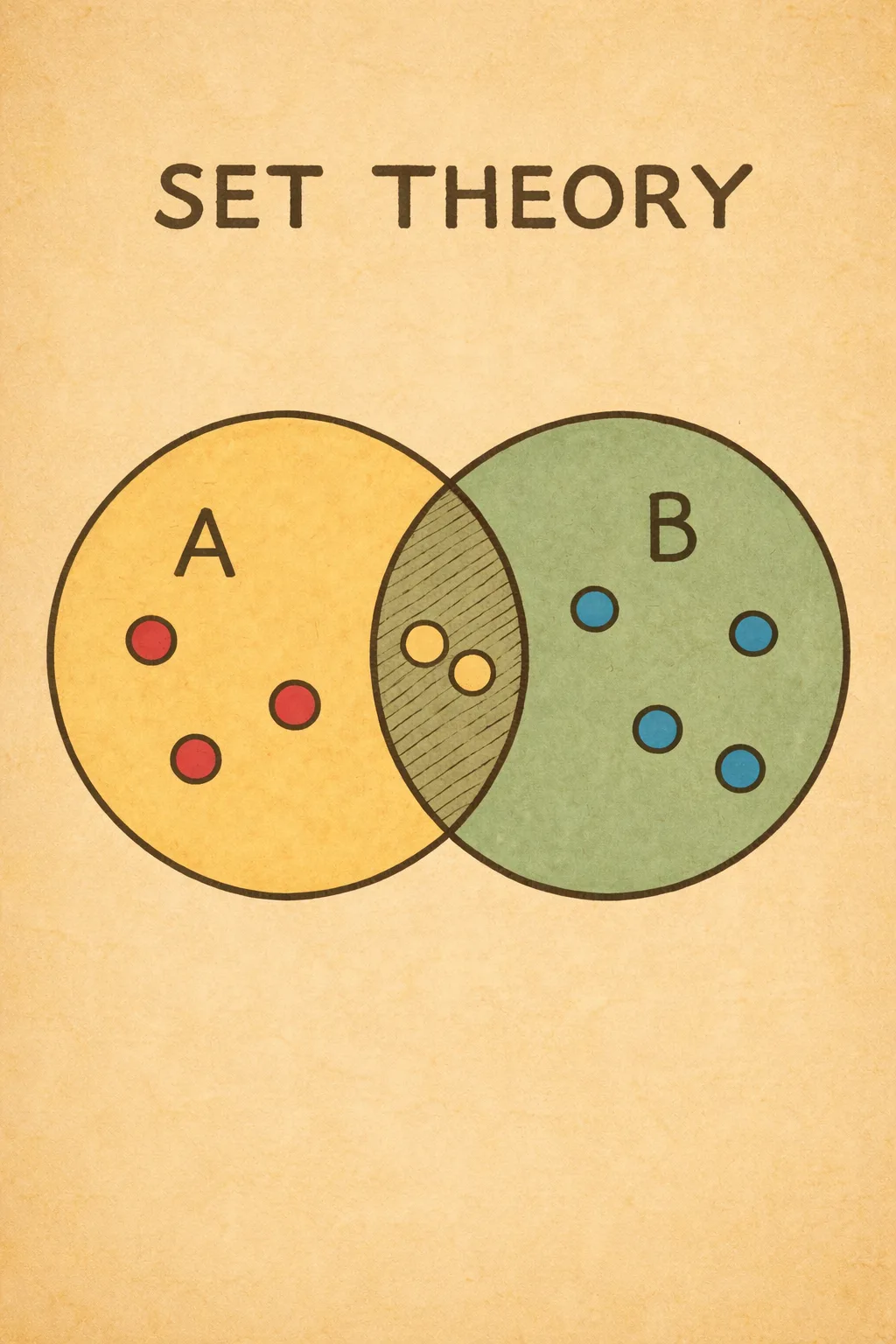
At the fish market, hilsa goes in one pile, rohu in another — every fish in exactly one pile, none left out. A set is a membership rule that gives the same answer no matter who checks it.
What's a relation?
A set asks “is this in?” A relation asks “are these two connected?” When a relation connects everything back to itself, reverses cleanly, and chains through a third element, it splits the whole set into neat, non-overlapping groups.
Connect playing cards that share a suit, and a shuffled deck splits into exactly four heaps — no card left over. Same remainder on division by 5, same blood group — same machine, everywhere.
2-Day Crash Course.Master this Chapter.
Click here.

Complex Numbers
Let's break algebra on purpose.
What's the square root of a negative number?
No real number gives one. In the 1500s, mathematicians solving cubic equations needed it anyway — using it mid-calculation, even for equations whose final answer was an ordinary real number. So they stopped refusing it and named it: i, defined by i² = −1. A number a + bi — real part and imaginary part — is a complex number, and ordinary algebra still works.
Where do complex numbers live?
Plot a + bi as the point (a, b). Multiply by i, and the point rotates exactly 90° around the origin — not approximately, exactly. That's why AC voltage, which rises and falls like a wave, is engineered using complex numbers: a wave is just what one coordinate of a steadily spinning arrow traces out.
2-Day Crash Course.Master this Chapter.
Click here.
Progressions
Let's start with a pattern.
What makes a list an “AP”?
A train gains speed steadily — the same extra push every second. That's an arithmetic progression (AP): the jump between terms never changes. Take 3, 7, 11, 15 — the jump is always 4. Starting from a first term a with common difference d, the nth term is a + (n−1)d.
What makes a list a “GP”?
Now think about a post going viral: you share it with 2 friends, each of them shares it with 2 more — 4, then 8, then 16. Each round doubles the last. That's a geometric progression (GP): multiply by the same ratio r each step, instead of adding.
Save Rs. 500 a month for two years and you reach Rs. 12,000 — steady AP growth. Double Re. 1 every month for fifteen months and you pass Rs. 32,000. APs grow at a steady pace. GPs start slow, then explode.
2-Day Crash Course.Master this Chapter.
Click here.

Logarithms
Let's turn multiplication into addition.
What does a logarithm actually ask?
logb x = k simply means bk = x — the logarithm is asking what power of the base gives you this number. log10 1000 = 3, because 10³ = 1000. That's the whole definition.
Why did this change navigation forever?
Multiplying huge numbers by hand is slow and error-prone. Logarithms convert it into addition: log(A × B) = log A + log B.
The Richter scale, decibels, pH — all logarithmic. A magnitude 7 earthquake releases about 32 times more energy than a magnitude 6. Same idea, every time something spans an enormous range.
2-Day Crash Course.Master this Chapter.
Click here.

Miscellaneous Equations
Let's meet miscellaneous equations.
What makes an equation “miscellaneous”?
Some equations don't belong to a tidy family — no formula, no standard method, just exponents, floors, and unknowns tangled together. The trick is spotting which of three ideas unlocks it.
Some tricks that you can use to unlock these questions are:
Symmetry: when swapping variables leaves the equation unchanged, the solution is symmetric too. Substitution: rename the ugly part — turn u³ into A — and a nightmare system becomes something a Class 5 student could solve. Constraints: a square is never negative, and that fact alone can pin down an answer with no calculation at all.
As an example, (x−y)² ≥ 0 may look vague. But combined with another information that says (x−y)² ≤ 0, it pins down x = y!
2-Day Crash Course.Master this Chapter.
Click here.

Mathematical Induction
How do you prove something for infinite number of cases, all at once?
Two steps. First, the base case: check it's true for n = 1. Second, the inductive step: prove that if it's true for some k, it must be true for k + 1. Together, two finite checks cover infinitely many cases.
Note that this is not just “checking a pattern”.
Checking the first thousand cases and noticing a pattern is a “guess”, not a proof. Induction is airtight: the step from k to k + 1 should work for every k.
But if you skip the base case, then the whole chain falls apart. You might have proven that dominoes knock each other over, but you did not prove that the first domino ever gets pushed.
2-Day Crash Course.Master this Chapter.
Click here.

Permutations and Combinations
Let's count without listing.
When does order matter?
Choosing who sits where — order matters, that's a permutation. Choosing who's on the team — order doesn't, that's a combination. Arranging 3 of 5 people in a row: 5 × 4 × 3 = 60 ways. Forming a 3-person team from the same 5: each team gets counted 3! = 6 times over, so the real answer is 60 ÷ 6 = 10.
Where does this actually matter?
Far beyond the classroom: cryptographers count key combinations to measure how hard a code is to crack, geneticists count possible arrangements of a DNA sequence, and quantum computers exploit the sheer number of ways qubits can combine to explore many possibilities at once instead of one. Counting without listing turns out to be one of the most load-bearing skills in modern science.
2-Day Crash Course.Master this Chapter.
Click here.

Binomial Theorem
Let's expand (a+b)² properly.
Why isn't (a+b)² just a² + b²?
(a+b)² = (a+b)(a+b) = a² + 2ab + b². That middle 2ab comes from two ways of picking one a and one b out of the two brackets. Every coefficient in a binomial expansion is really a count: how many ways can you pick b from exactly r of the n brackets?
Where does this actually matter?
A quantum computer holding n qubits in superposition exists across all 2ⁿ outcomes at once, and the weight given to each outcome comes from the very same row of Pascal's triangle you just used to expand (a+b)ⁿ.
2-Day Crash Course.Master this Chapter.
Click here.

Determinants
Let's see what ad − bc can do.
What does one number tell you about two equations?
For ax + by = e and cx + dy = f, the value ad − bc decides everything. Zero, and the system has no solution or infinitely many. Nonzero, and there's exactly one. This number is the determinant.
Where does this actually matter?
A robotic arm's control software checks the determinant of its Jacobian matrix thousands of times a second — the instant it hits zero, the arm has reached a singularity, a pose where it briefly loses a full degree of freedom and control commands stop making sense.
2-Day Crash Course.Master this Chapter.
Click here.

Matrices
Let's add two tables together.
What can you do with a grid of numbers?
A matrix is just a rectangular table of numbers. Add two matrices of the same size by adding matching entries — nothing more. Multiply by a single number, and every entry scales.
Where does this actually matter?
Every operation a quantum computer performs — flipping a qubit, entangling two of them — is a matrix multiplying a state vector. A quantum gate is nothing but a specially constrained matrix, one built so it never lets probability leak away.
2-Day Crash Course.Master this Chapter.
Click here.
Trigonometry

Trigonometric Identities
Let's start on a circle of radius 1.
Where does sine actually come from?
Indian astronomers tracking the moon needed to describe an oscillating position, so they measured a length: drop a perpendicular from a point on a circle of radius 1 down to the horizontal, and that length is the sine. The word travelled Sanskrit to Arabic to Latin and became “sine.”
Where does this actually matter?
Every AC power grid runs on this fact in disguise: voltage and current are both sine waves, phase-shifted from each other.
2-Day Crash Course.Master this Chapter.
Click here.

Trigonometric Equations
Let's solve sin θ = 1/2 completely.
Why doesn't a trig equation stop at two answers?
Solve x² = 4 and you get exactly two roots, done. Solve sin θ = 1/2 and you get θ = 30°, then 150°, then 390°, then 510° — forever in both directions. Sine repeats every 360°, so once you find one solution, adding any multiple of 360° gives another.
Where does this actually matter?
Astronomers hunting for exoplanets watch for a dip in starlight that repeats at a fixed period — mathematically, that's solving for every time t satisfying a periodic equation just like this one, except the period is measured in days instead of degrees.
2-Day Crash Course.Master this Chapter.
Click here.

Inverse Circular Functions
Let's undo sine, carefully.
Why can't sine just be “undone” directly?
sin(30°) and sin(150°) are both 1/2 — sine repeats forever, so “which angle has this sine” has infinitely many answers. An inverse needs exactly one answer per input, so mathematicians restricted sine to one clean stretch, −90° to 90°, where it never repeats. On that stretch, sine has a proper inverse: arcsin, written sin⁻¹.
Where does this actually matter?
Converting a star's position into the angles a telescope actually points to — right ascension and declination — runs straight through arcsin and arctan, the very inverses you just met, applied to a 3D coordinate instead of a ratio.
2-Day Crash Course.Master this Chapter.
Click here.

Properties of Triangles
Three angles alone tell you nothing about size.
Why do you need more than the angles?
A triangle with angles 60°, 70°, 50° could be tiny or enormous — angles fix the shape, not the scale. You need at least one side too. Once you have enough information, the sine rule and cosine rule unlock everything else.
Where does this actually matter?
Astronomers measure the distance to a nearby star using the sine rule you just used on a triangle drawn in a notebook.
2-Day Crash Course.Master this Chapter.
Click here.

Height and Distance
Let's measure a building without climbing it.
What's the one triangle behind every problem here?
Stand a distance d from a tower, look up at angle θ, and the height is h = d·tan θ. One right triangle, one ratio. At 45°, height equals distance exactly. At 60°, height is √3 times the distance.
Where does this actually matter?
Seismologists locate how deep underground an earthquake began using angle-of-elevation triangulation from several monitoring stations.
2-Day Crash Course.Master this Chapter.
Click here.
Geometry

Straight Line
Let's give every point an address.
What connects a picture of a line to an equation?
Every point in the plane gets coordinates (x, y): how far right, how far up. A straight line becomes a linear equation in x and y, and “the point is on the line” becomes “its coordinates satisfy the equation” — geometry and algebra doing the same job.
Where does this actually matter?
Engineers testing a new alloy, plot stress against strain. As long as the material stays within its elastic range, that graph is a straight line. Its slope is called Young's modulus.
2-Day Crash Course.Master this Chapter.
Click here.

Circles
Drop a stone in still water.
What is a circle, really?
Every point on a ripple is the exact same distance from where the stone landed. That's the whole definition: a circle is every point in a plane the same distance — the radius — from one fixed centre.
Where does this actually matter?
The Large Hadron Collider bends beams of protons around a 27-kilometre circle using magnetic fields. The same equation you just derived, running at nearly the speed of light.
2-Day Crash Course.Master this Chapter.
Click here.

Pair of Straight Lines
Let's write two lines as one equation.
How can one equation hold two lines at once?
y = 2x and y = 3x are two separate lines. Multiply them together: (y−2x)(y−3x) = 0. That single equation is satisfied whenever either line's equation is zero — one expression, two lines, living in the same house.
Where does this actually matter?
A video game's physics engine checks whether two edges of a moving object are about to cross using exactly this kind of paired-line equation. This is why characters stop cleanly at a wall instead of walking through it.
2-Day Crash Course.Master this Chapter.
Click here.

Parabola
Let's point a dish antenna the right way.
What makes a parabola focus signals perfectly?
A parabola is every point equally distant from a fixed point (the focus) and a fixed line (the directrix). Every incoming ray parallel to its axis reflects off the curve and passes through the focus — exactly, every time. That's why satellite dishes, headlight reflectors, and telescope mirrors are all parabolic.
Where does this actually matter?
Every radio telescope dish, from a backyard satellite receiver to the giant collectors scanning deep space for faint signals, is shaped as a parabola for one reason: it's the only curve where every incoming ray, no matter where it lands, reflects to the exact same focus point.
2-Day Crash Course.Master this Chapter.
Click here.

Ellipse
Tie a string between two pins.
What is an ellipse, really?
Press two pins into a board, loop a loose string around them, and trace with a pencil while keeping the string taut. The pencil draws an ellipse — because the string length never changes, the sum of the distances from any point on the curve to the two pins stays constant.
Where does this actually matter?
Every spacecraft sent to Mars follows a Hohmann transfer orbit — half of an ellipse, timed so the ship and the planet reach the same point in space at the same moment, using the least fuel physically possible.
2-Day Crash Course.Master this Chapter.
Click here.

Hyperbola
Let's switch a plus sign to a minus.
What changes when “sum” becomes “difference”?
An ellipse is the set of points where the distances to two fixed foci sum to a constant. A hyperbola is where the difference of those distances stays constant instead. One sign change, and a closed loop becomes two open branches, curving away from each other forever.
Where does this actually matter?
When the interstellar visitor ‘Oumuamua passed through our solar system in 2017, astronomers confirmed it wasn't native here from one signature alone: its path through the Sun's gravity was a hyperbola, not an ellipse — proof it was never bound to orbit us at all.
2-Day Crash Course.Master this Chapter.
Click here.

3D Geometry
Let's add a third axis.
What changes when you add a z-axis?
2D gives every point two coordinates: how far right, how far up. Add a z-axis, perpendicular to both, and every point in space gets three: (x, y, z). Distance still works the same way, just with one more squared term under the root.
Where does this actually matter?
An MRI scanner builds a 3D image of the inside of your body from hundreds of flat 2D slices, stacking them along a z-axis and stitching them together using exactly the three-coordinate geometry that you will learn.
2-Day Crash Course.Master this Chapter.
Click here.

Vectors
Let's give a direction to a number.
What does a vector add that a plain number can't?
“Walk 500 metres” is useless without a direction. A vector carries both: magnitude and direction, drawn as an arrow. Add two vectors tip to tail, and you get the combined displacement — walk 3 steps east, then 4 north, and you land at one specific point regardless of order.
Where does this actually matter?
A qubit's exact state is a vector — not an arrow through ordinary space, but one pointing somewhere on a sphere of possibilities, and every quantum computation is really just rotating that vector through precise, reversible steps.
2-Day Crash Course.Master this Chapter.
Click here.
Differential Calculus

Functions
Let's not repeat a username.
What actually makes something a function?
Every input maps to exactly one output — that's the whole rule. A chai stall charging a fixed price per cup is a function: cups in, total price out, always one price per order. What's not allowed is one input giving two different outputs.
Where does this actually matter?
Modern encryption leans on functions that are easy to compute forward and practically impossible to reverse: multiplying two huge prime numbers takes a computer milliseconds, but factoring the result back apart can take longer than the age of the universe.
2-Day Crash Course.Master this Chapter.
Click here.

Limits
Let's approach without arriving.
What does it actually mean to “approach” a value?
A limit doesn't care what happens exactly at a point — only what a function gets closer and closer to as you approach it. If the value it heads toward from the left matches the value from the right, that shared destination is the limit. If they don't match, the limit doesn't exist.
Where does this actually matter?
To a distant observer, a spacecraft falling toward a black hole never quite crosses the event horizon — its image just gets dimmer and slower forever, approaching that boundary the same way a limit approaches a value without ever technically arriving.
2-Day Crash Course.Master this Chapter.
Click here.

Continuity
Trace the graph without lifting the pen.
What makes a function “continuous” at a point?
Trace a function's graph with a pen. If you never have to lift it, the function is continuous. Precisely: the value it approaches from the left, from the right, and the value it actually has at that point — all three must agree. Disagree on any one, and there's a break.
Where does this actually matter?
A digital audio signal is rebuilt as a continuous waveform before it reaches your speakers — any break in that continuity is exactly what you'd hear as a click or a glitch, which is why audio engineers guard continuity as fiercely as mathematicians do.
2-Day Crash Course.Master this Chapter.
Click here.

Differentiability
Let's zoom into a corner.
Why isn't “no breaks” the same as “smooth”?
Continuity means you can trace the graph without lifting your pen. Differentiability asks something sharper: is there one well-defined slope at every point? |x| is continuous everywhere, but at x = 0 it has a sharp corner — slope −1 from the left, +1 from the right, and they never agree.
Where does this actually matter?
A valid quantum wavefunction can't have a sharp corner: the Schrödinger equation involves a second derivative, so the function describing where a particle is likely to be found has to stay smooth enough to differentiate twice, or the physics breaks down.
2-Day Crash Course.Master this Chapter.
Click here.

Derivatives
Let's find speed at a single instant.
What does a derivative actually compute?
“Total distance ÷ total time” only gives average speed. A derivative asks for the rate of change at one exact instant — nudge x by a tiny amount h, see how much the output changes, divide by h, then shrink h to zero. That limit is dy/dx.
Where does this actually matter?
Every drone that hovers steadily instead of drifting into wild oscillation owes it to a derivative: its flight controller reacts not just to how far off course it is, but to how fast that error is changing (the derivative).
2-Day Crash Course.Master this Chapter.
Click here.

Tangents and Normals
Let's touch a curve at exactly one point.
What is a tangent line, precisely?
Take two points on a curve and draw a line through them — a secant. Slide the two points together until they merge into one, and the secant settles into a specific limiting line: the tangent. Its slope at (a, f(a)) is exactly f′(a), the derivative there.
Where does this actually matter?
In LASIK eye surgery, the laser must strike the cornea's curved surface at a precisely calculated angle relative to its normal at every point.
2-Day Crash Course.Master this Chapter.
Click here.

Maxima and Minima
Let's fence the biggest possible yard.
Why does a horizontal tangent mark a peak or a valley?
At a smooth local maximum or minimum, the curve is momentarily flat — the tangent is horizontal, so the derivative is zero. These are called critical points, and every optimisation problem starts by hunting for them.
Where does this actually matter?
Blood vessels branching inside your body follow Murray's Law, an angle and radius ratio that minimises the total energy your heart spends pumping — evolution independently arrived at the same optimisation calculus you just used on a fence.
2-Day Crash Course.Master this Chapter.
Click here.
Integral Calculus

Integration
Let's undo a derivative.
What question does integration actually ask?
Given a derivative, can you find the original function back? If f′(x) = 2x, then f(x) = x² — but so does x² + 5, and x² − π, and infinitely many others differing only by a constant, C. Integration finds the whole family at once; that's what the “+ C” means.
Where does this actually matter?
Hydrologists measure how much water a river actually carries by integrating its flow rate over time — the same “area under the curve” idea, just measured in cubic metres of water instead of square units on a graph.
2-Day Crash Course.Master this Chapter.
Click here.

Differential Equations
Let's solve for a whole function at once.
What's different about a differential equation?
Instead of “find x such that x = 5,” it asks “find f(x) such that f′(x) = 3x².” The answer isn't a number — it's a family of functions, y = x³ + C. Pin down one member with a starting condition: y(0) = 5 forces C = 5.
Where does this actually matter?
Quantum mechanics' central equation, the Schrödinger equation, is itself a differential equation — solve it once for a given system, and you get that particle's entire future behaviour, encoded as probabilities, for all time at once.
2-Day Crash Course.Master this Chapter.
Click here.
Data Science

Probability
Let's roll a die three times.
What's the chance of getting at least one six?
Roll once, roll again, roll a third time. It's tempting to just add up the chance of a six each time: 1/6 + 1/6 + 1/6 = 1/2, like flipping a coin. But that quietly counts twice over any set of rolls where two or three sixes turn up. The safe way is to find the chance of missing every single time instead — (5/6)³ = 125/216 — and subtract that from 1. That gives 91/216, the correct answer.
Where does this actually matter?
In quantum mechanics, a particle has no definite position until it's measured — only a probability for each possible outcome, found by squaring the wavefunction, the same core logic you just used to find the chance of rolling a six.
2-Day Crash Course.Master this Chapter.
Click here.

Statistics
Let's find the centre of a pile of numbers.
Mean, median, or mode — which do you trust?
The mean uses every value, but one extreme number can drag it far from where most of the data sits. The median — the middle value once everything's sorted — ignores outliers entirely. For 10, 10, 50, 50, 100000, the mean is about 20,024; the median is 50. The median is the honest one here.
Where does this actually matter?
Astronomers cleaning up noisy telescope images often use a median filter instead of an average: one stray cosmic-ray hit can drag a mean wildly off, but the median just shrugs it off — the exact same outlier-resistance you just saw with that one huge number.
2-Day Crash Course.Master this Chapter.
Click here.